Consumer Duty outcome 2: Are 1 in 6 of your clients unsure how they pay you?

Advisers have four ‘outcomes’ to consider under the FCA’s new Consumer Duty regulations: products and services, price and value, consumer understanding and consumer support.

This article looks at the second of these – ‘price and value’ – and the requirement of firms to “ensure clients are receiving fair value when it comes to the price of products and services”.

The FCA says fair value is two-fold:

  • The product or service must meet the needs of the client.
  • The product or service must be offered at a fair price.


The first of these is all about understanding clients’ needs, which we discuss here.

The second is about offering advice at a ‘fair price’. But how do you prove your advice offers value for money?

And can you demonstrate value at all if clients don’t really understand cost?

Through our Elevation platform, we’ve analysed over 250,000 prospect/client reviews to help firms understand and evidence the value they offer clients.

Fair value doesn’t need to mean cheap

The FCA says that “Firms [are required to] demonstrate that there remains a reasonable relationship between the total price of the product or service and the benefits the customer receives”. 

It’s important that advisers don’t conflate the word ‘value’ with ‘cheap’.  The Consumer Duty doesn’t pass judgement on a firm’s fees.  Instead, it requires firms to ensure their fees are justified.

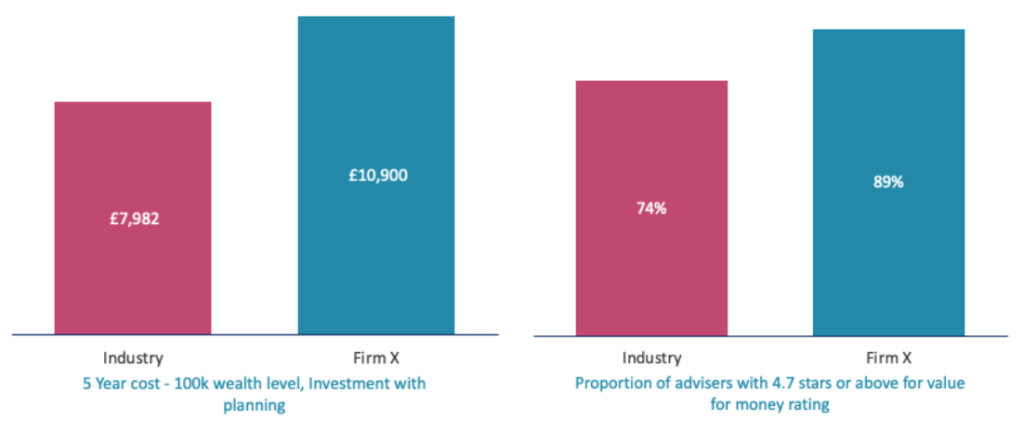
For example, the fees of one national advice firm on Elevation are 35% more than the industry average.  On assets worth £100,000, over a five year period, the firm charges £10,900, vs £7,982 industry average.

However, even though the firm charges more for its advice than a typical firm, its ‘value for money’ score is also higher than the market average.  Based on the data, 89% of their advisers are rated 4.7 stars out of five or better for ‘value for money’, compared to 74% of the market as a whole.
Understanding fees

Before firms can point the FCA to client feedback on ‘value for money’, they need to be confident that clients understand the fees they are paying for advice.  After all, it is hard to judge value without knowing the cost.

However, Elevation data found that one in six clients don’t know how they pay for their advice.  This rises to one in two prospective clients.
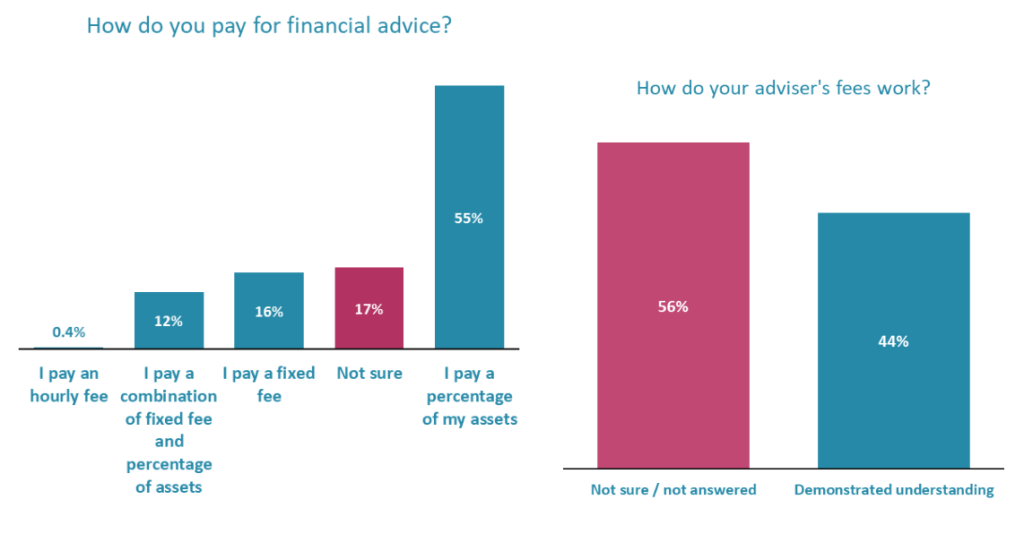
This should ring an alarm bell for advisers.  If they forget to clearly outline how their advice is paid for, they will fail to meet the requirements of this second part of the Consumer Duty.  If advisers feel they have outlined their fees, it’s possible that their communications aren’t clear, or aren’t being read.

However, the issue is easily fixed, as it’s often a question of reminding clients regularly, and repeating information more than once. 

Advisers who are apprehensive about giving their fees too much emphasis shouldn’t be: Elevation data shows that prospective clients who are clear about their adviser’s fees are over 40% more likely to convert than those who are not sure.

The importance of asking questions

Diligent advisers will no doubt be keen to check all their clients are clear on the fundamentals of their service.  The most effective way to do this is to ask them.  This will help to show the FCA that they’re compliant with this part of the Consumer Duty.

Firms could conduct customer research or use internal data to assess if a service offers fair value. Elevation goes further, giving firms adviser-level data, benchmarked against the industry, to monitor whether clients think they are getting fair value for the price they are paying.

Feedback from the Elevation platform can help show your firm and advisers how they benchmark against the industry and can help you evidence the value you’re providing to customers.

___________________________

Elevation, from VouchedFor, uses client feedback to drive business growth.  Powered by 250,000 clients’ feedback, it identifies which factors make the biggest positive difference to client experience, and uses carefully engineered questions within a client survey to reveal how advice firms are tracking against them.

Elevation helps you drive advocacy from existing clients, improve conversion of prospective clients, and mitigate risk by identifying issues early.  


To find out how Elevation can help you, or if you’re interested in getting content to help you meet your Consumer Duty, contact elevation@vouchedfor.co.uk

Consumer Duty outcome 1: 4 top tips to ace ‘Products and Services’

Advisers who are directly interacting with clients, and senior staff within a firm, need to fully embrace the Consumer Duty as the scope of the new rules, which are phased in from July 2023, is huge. There are four outcomes each firm is expected to monitor and evidence:

  • Products and services
  • Price and value
  • Consumer understanding
  • Consumer support


In this article, we look at the first of these – products and services – and how far away from the FCA’s expectations firms are now?

Elevation, a VouchedFor platform, has analysed over 250,000 prospect/client reviews to reveal how well firms are currently meeting the Consumer Duty ‘Products and Services’ outcome. The data shows that most advisers are doing a good job, but there are still opportunities to improve.

We’ve identified four top tips to help you address this outcome in your implementation plan.

1. Get to grips with client needs

Under the ‘Products and Services’ Outcome, distributors “must ensure the needs, characteristics and objectives of the target market are taken into account,” according to the FCA rules. So, advisers must uncover and document client motivations and objectives from the very start of the adviser-client relationship, beginning when clients are prospects.

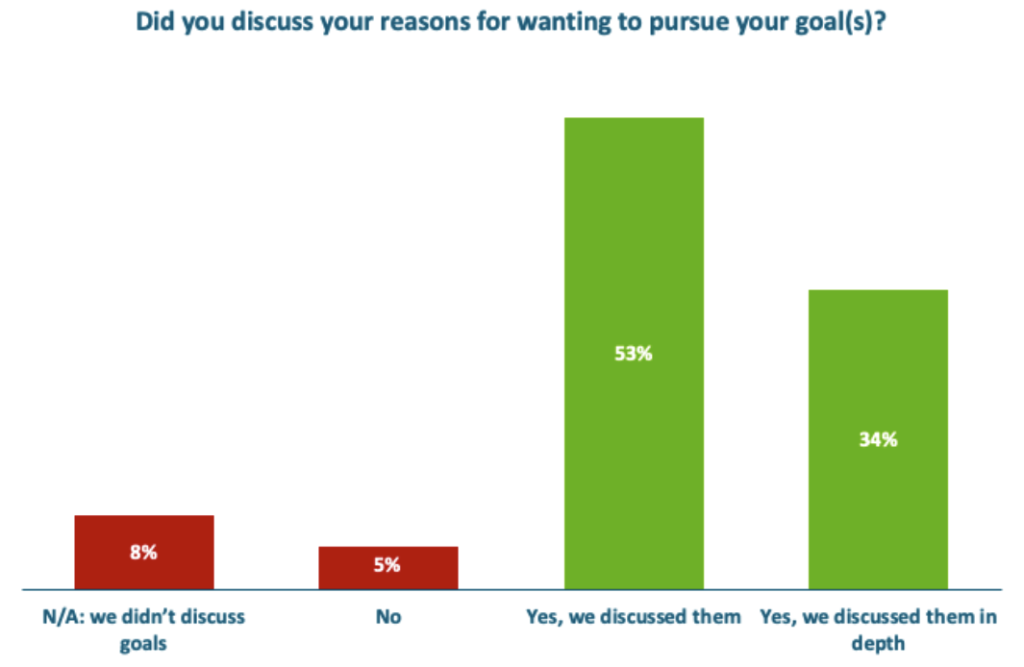
Nearly nine in 10 (87%) prospective clients said they did discuss their motivations for pursuing their goals with their adviser, according to Elevation data. This is positive. But there is considerable room for improvement, as just 34% of these prospective clients said they discussed their goals in depth.

A small minority (13%) said they did not discuss their goals or reasons for pursuing them, meaning these firms are unlikely to be compliant with the Consumer Duty regulations without making changes.

Helena Wardle, a Chartered Financial Planner and Director of Smith & Wardle, emphasises how emotional the subject of money is for many people, and encourages her clients to discuss their motivations, experiences and fears. “We really focus on trying to help the client be comfortable and we do this by making it clear the meeting is for their benefit not ours.” She also focuses on goals in the first meeting, by not asking how much money a client has.

2. Keep the conversation going

Ongoing conversations are an important part of Consumer Duty compliance. People may start with a specific motivation or goal, but these can easily change over time. So, it is no surprise that the FCA expects advisers to “carry out regular reviews to ensure their products/services continually meet the needs of the target market”.

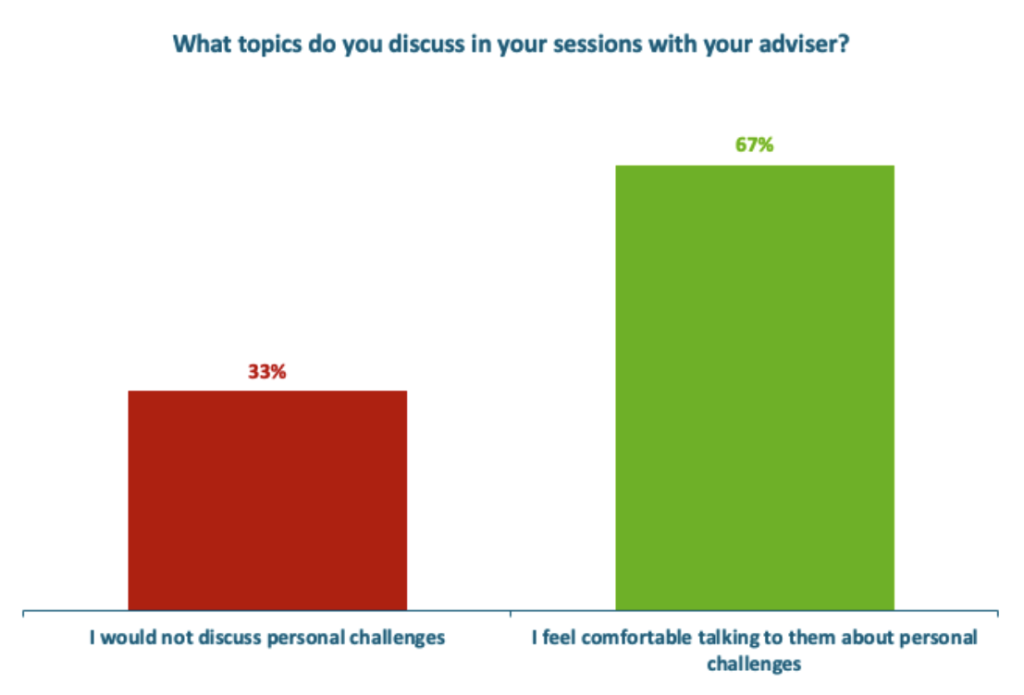
Even though advisers may speak to their clients regularly, they need to be sure that they put clients at ease and allow them to feel free to discuss any concerns they have. Yet one third of clients don’t feel comfortable discussing personal challenges with their adviser.

3. Ensure clients understand risk

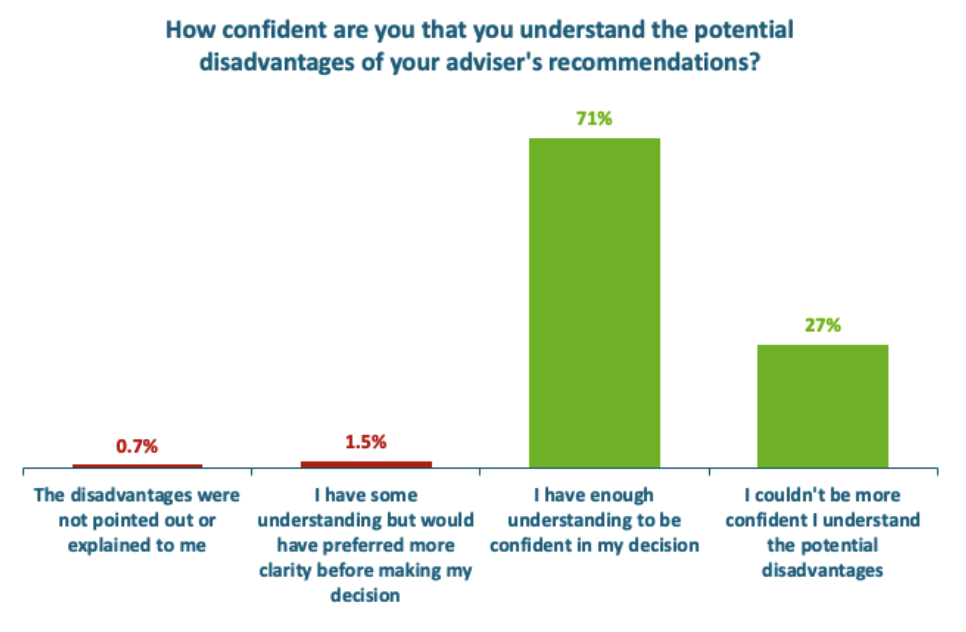
Advisers must also be sure that clients understand the potential risks or disadvantages of their recommendations. The ‘Products and Services’ outcome also specifies that distribution arrangements “must avoid causing and, where that is not practical, mitigate foreseeable harm to customers”. All risks must be proportionate to the client’s objectives.

Advisers already seem to be doing well at this. Almost all clients (98%) were confident that they understood the potential disadvantages of their adviser’s recommendations, and approximately one quarter of these clients “couldn’t be more confident”, which would clearly meet or exceed the Consumer Duty requirements. Just 2.2% of clients said they didn’t have sufficient understanding, according to the Elevation data.

4. Conduct regular reviews

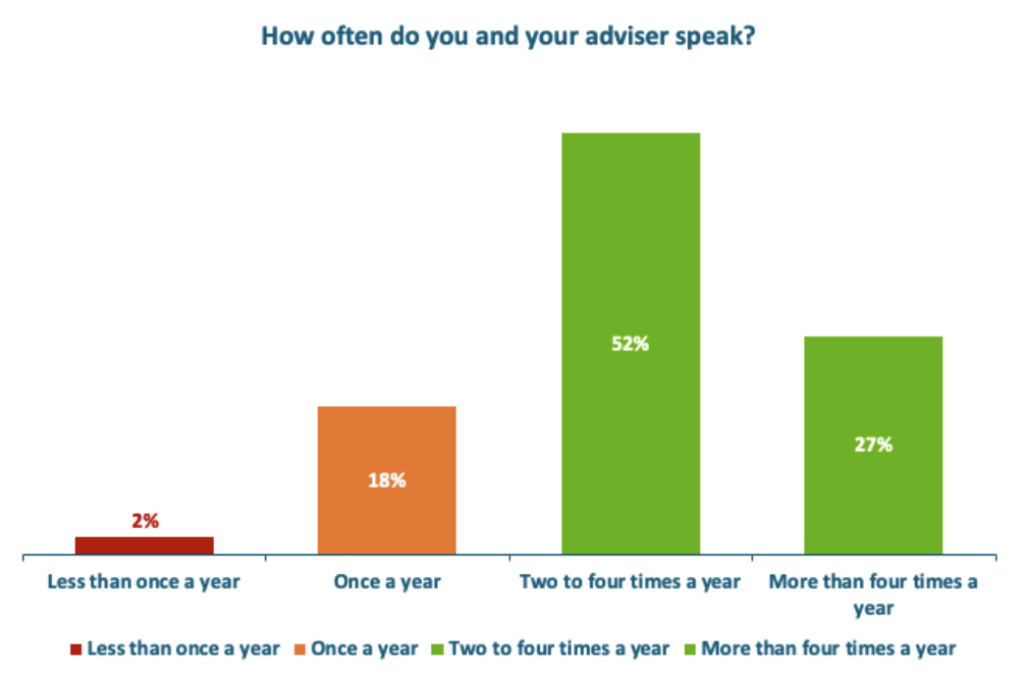
Ongoing reviews are happening, but are they happening often enough? The Elevation data shows that 27% of clients are meeting with their advisers at least four times a year, with 80% meeting at least twice a year. There is room for improvement, though, as one in five clients only speak with their adviser once a year or less.

The Elevation data suggests that most advisers are doing relatively well when it comes to future compliance with the Consumer Duty, but there is still work to be done. It is also vital that advisers continue to monitor their performance, so they keep improving. 

Elevation, a VouchedFor platform, streamlines client feedback on behalf of advisers, and provides real-time and continuous analysis for constant insights and proactive identification of issues. To find out how Elevation can help you, see how your reviews stack up against the industry and if you’re interested in getting content to help you meet your Consumer Duty, contact elevation@vouchedfor.co.uk
Revealed: how to boost client confidence and generate more recommendations

VouchedFor’s new Elevation system has analysed over 250,000 client reviews and shows that client confidence has a key role to play. Put simply, the more confident a client feels in their adviser, the more likely they are to recommend them.

But how can you increase your clients’ confidence? This short blog uses Elevation data to reveal the most important adviser behaviours in upping client confidence and the number of recommendations you receive.

But first, a quick word on why client recommendations are so important…

Why client recommendations are vital for your business

Recommendations tell you how satisfied your client is

Client recommendations are an invaluable indicator of how satisfied your client is with your services. There’s no greater compliment than a client recommending your services to someone.

Client recommendations have a higher rate of conversion

From a marketing point of view, client recommendations are like gold-dust. People are far more likely to trust you and become a client if someone they trust recommended you.

Reach similar client demographics

Your existing clients are likely to recommend you to people like them. This means whoever they recommend you to is more likely to fit your ideal client profile and demographic.

Client recommendations require minimal cost

Client recommendations are organic marketing at its very best and most powerful. Generating client recommendations typically requires much less cost than other forms of marketing.

What makes a confident financial advice client?

Unfortunately, simply ‘doing a good job’ and ticking all the boxes doesn’t necessarily translate into confident clients or recommendations. For this reason, we analysed what specifically within a client’s experience motivates them to recommend their adviser’s services.

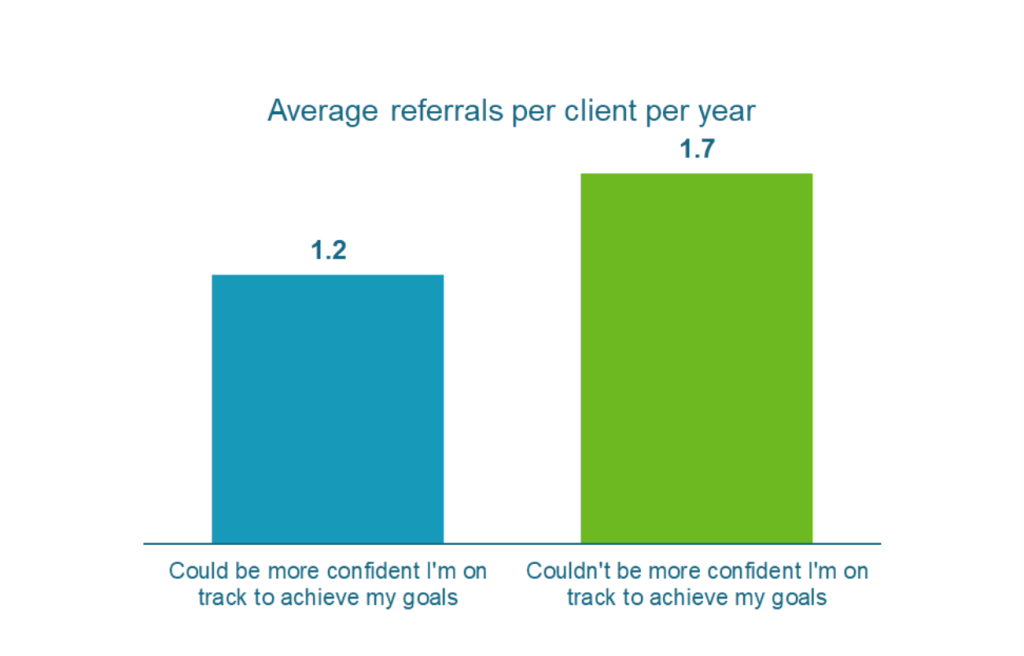
Being on track to meet their goals

We found that clients who answered ‘I couldn’t feel more confident I’m on track [to achieve my goals]’ recommend their advisers 1.7 times a year on average. This equates to 37% more recommendations than clients who gave an answer that indicated that they could have been more confident.

However, don’t be disheartened. Only 19% of the clients we asked gave the best answer to this question. This means that there is the opportunity to up the confidence of 81% of clients. And, in so doing, generate more recommendations!

This could include formulating clear milestones together with your clients, continually referring back to progress vs goals, and conducting regular reviews. It may sound obvious but directly asking clients how confident they are that they are on track to achieve their goals is important too.

Our Elevation system gathers this feedback for you. It also gives you visibility on how your clients’ answers compare with the rest of the industry, including areas where you’re strongest and areas for improvement.

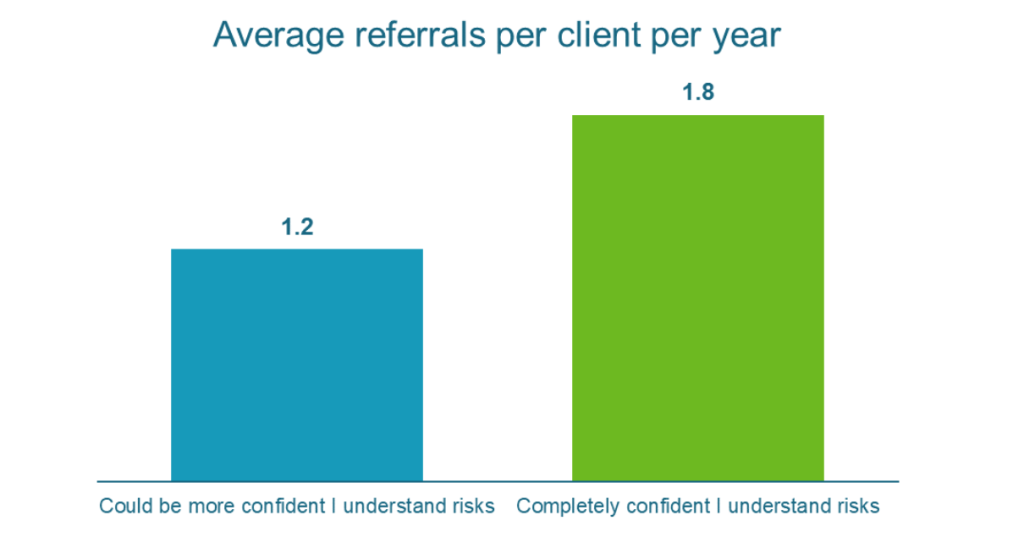
Having a solid understanding of the risks involved

We also found that clients who feel fully informed about the risks associated with their financial adviser’s work would recommend their adviser 1.8 times a year on average. This translates to 50% more recommendations compared to clients who feel they could have a better understanding of the risks involved.

The importance of understanding risk varies depending on the age of the client. Our Elevation data shows that for clients aged 66 or over, full understanding of the risk associated with their adviser’s work makes them 69% more likely to recommend.

Feeling confident?

In conclusion, genuinely confident clients will generate far more of the best enquiries – recommendations. And there are clear steps that most advisers can take to build their clients’ confidence and generate more recommendations.  

Here at VouchedFor, we’re passionate about helping advisers deliver and showcase excellent client experience. If you’d like more cross-industry insights from our Elevation system to help improve client experience, we’d love to hear from you.

3 ways to increase your conversion rate

Conversion rate may sound a bit dull. But before you roll your eyes at another marketing metric, it’s worth noting that even a slight increase in your conversion rate – the percentage of new enquiries that go on to become paying clients – saves you time and grows your revenue. 

Our data indicates that many advisers could double their prospect conversion rate by adopting a few simple changes. Read on to find out how.

First impressions count

Everyone knows first impressions matter. It’s especially true when meeting a prospect for the first time. That’s why we gather First Impression Reviews after every prospect’s introductory meeting.      

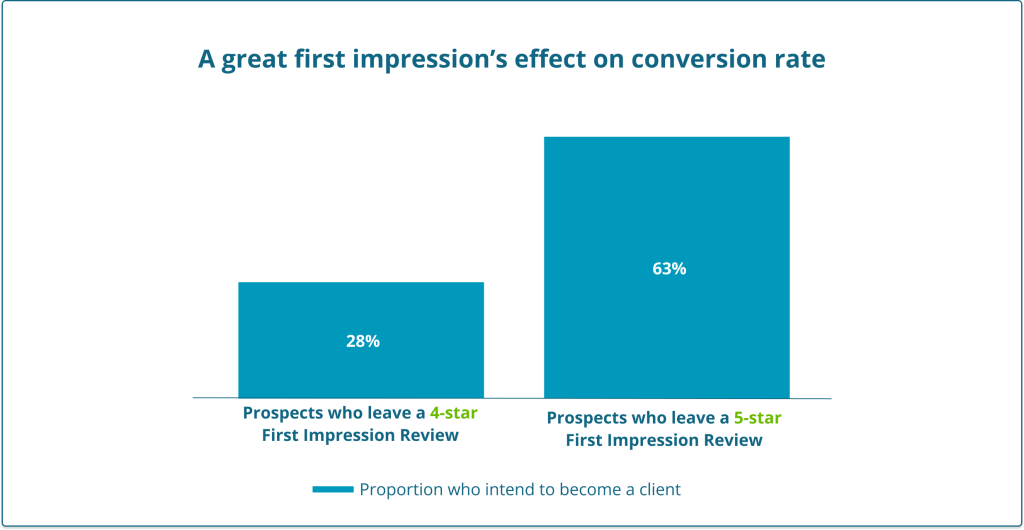
As you can see, 63% of prospects who leave a 5-star First Impression Review tell us they intend to become a client. However, this figure more than halves to 28% for those who leave a 4-star review. 

The stats speak for themselves. Creating a good first impression is vital if you want to increase your conversion rate and build long-lasting relationships with clients.

How to improve your conversion rate?

So how can you drive improvement and move an average 4 or 4.5 out of 5 rating up to a 5? Our new Safeguard system, which uses feedback and cross-industry insights to help firms improve client experience and mitigate risk, has identified three main ways advisers can make a better first impression and increase conversions.

1. Discuss prospects’ motivations in depth

Most people are looking for an adviser who goes beyond what goals they want to achieve (such as comfortable retirement or funding their children’s education) to really understand why they want to achieve them.

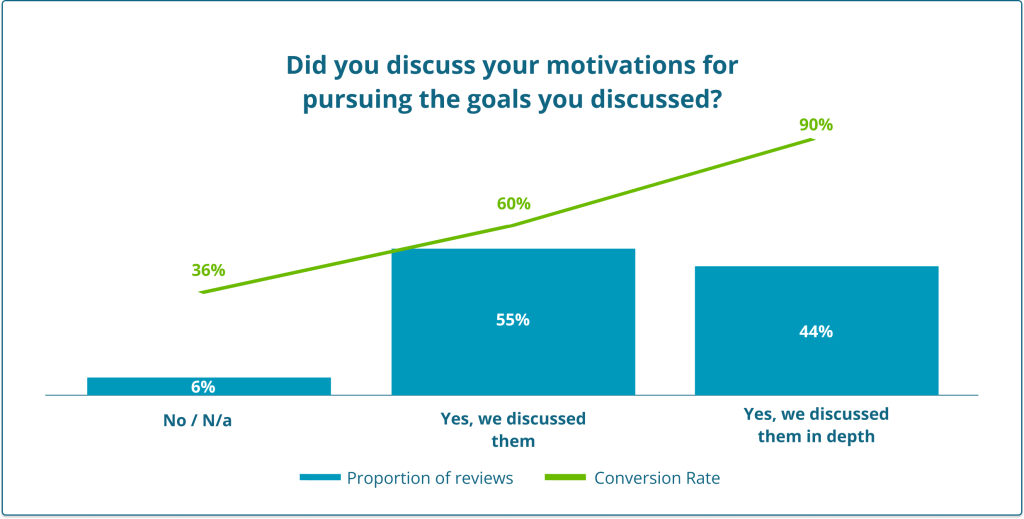
The chart below demonstrates how an in-depth discussion of prospects’ motivations in an initial meeting affects conversion rate.

Where in-depth discussions of prospects’ motivations took place, the conversion rate is an impressive 90%. This falls to just 36% where the conversation about the prospects’ motivations didn’t happen at all.

2. Outline clear actions to achieve goals

When choosing an adviser, prospective clients want to hear genuine solutions. They need a clear sense of how you will help achieve their goals. 

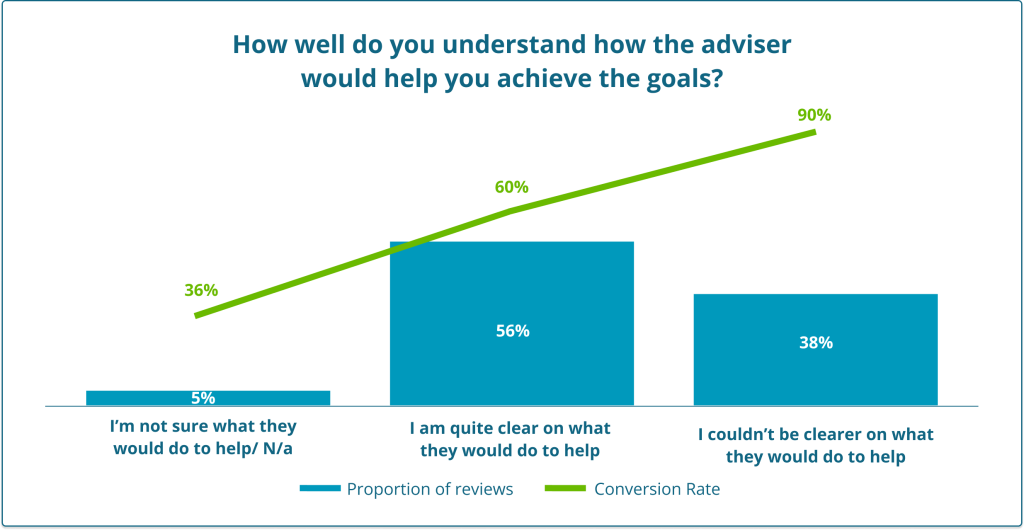
As the graph below shows, the conversion rate is a robust 85% in cases where the prospect fully understands how the adviser can help them achieve their goals. This drops to just 23% where the opposite is true.

3. Be transparent on fees

Discussing fees can make some advisers uncomfortable, but it’s a vital part of any prospect meeting. Prospective clients are looking for clear communication about your fee structure. If you’re not forthcoming with this information then you risk confusion and your conversion rate will suffer. 

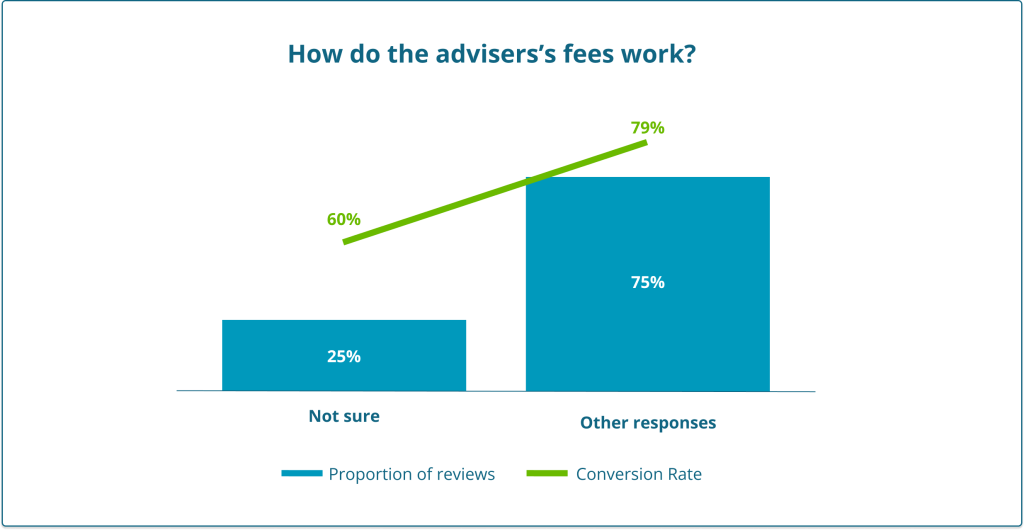
The takeaway? Be transparent and clear about your fees to build trust with prospects. There’s no guarantee they’ll go on to become a paying client but, as the chart shows, the conversion rate is notably higher when fees are communicated clearly.

Revealed: why advisers are missing a trick with VouchedFor

Brian Hill became an independent financial adviser (IFA) in 2007 having struggled to find an adviser who put his needs first. He is a big advocate of building public confidence in financial advice and recently completed a Master’s dissertation on the subject.

Brian is a member of VouchedFor, the adviser rating platform, on which he has built a rating of 4.8 out of 5 based on 88 verified client reviews. His firm, Jones Hill, was also one of only 16 firms to meet VouchedFor‘s 2020 Top Rated Firm criteria. He believes VouchedFor‘s core value lies in the independent validation it provides to prospects and clients.

“While it’s true that people find and make contact with me through VouchedFor, treating the platform purely as a lead generator risks disappointment and, more importantly, risks missing out on the bigger prize!” says Brian. 

“There’s no question that VouchedFor’s independently-verified reviews encourage more of my clients to refer to me”

“Of course the best way to generate client referrals is to deliver a transparent, brilliant service. But there’s no question that VouchedFor’s independently-verified reviews encourage more of my clients to refer to me, as well as building confidence with those they refer.

Added to this, a bit like TripAdvisor, many people find me on VouchedFor but choose to make contact through my own website.”

As of March 2019, VouchedFor gives advisers like Brian stats to help better quantify these benefits. Brian’s stats since March 2019 are detailed below:

Brian continues, “Many of my financial planning  clients come from, but not necessarily through, VouchedFor. Marketing is like a football team with VouchedFor as my wingers. They may not score goals directly, but many goals wouldn’t happen without them!”

VouchedFor’s adviser proposition has changed significantly in recent years. Brian is on VouchedFor’s £45+VAT per month Verified Membership, which gives advisers various tools to demonstrate their client rating, review count and checks to everyone they contact. It’s designed to offer value whether advisers receive enquiries directly through VouchedFor or not.

“A bit like TripAdvisor, many people find me on VouchedFor but choose to make contact through my own website”

VouchedFor has also introduced more checks to help inform consumers. These include making clear whether advisers display their fees, showing how many recent reviews each adviser has and enabling advisers to invite annual ‘follow-up’ reviews. VouchedFor also invites everyone who contacts an adviser through its platform to leave a ‘first impression’ review and displays the percentage of first impression reviews that are positive on each adviser’s profile.

Brian concludes, “I’m passionate about increasing transparency across the financial advice profession and to that end, I’m keen to see as many firms as possible encouraging all their clients to review them regularly and publishing their review count/rating.  But, from a competitive perspective, the more advisers who don’t, the better it is for my business!”

5 tips to turn your prospects into your clients

At this time of peak uncertainty, it is more important than ever to make the most of every possible prospect. With markets experiencing huge volatility, many people are in desperate need of financial advice, but may not know where to turn.

If someone who has a genuine need for your services reaches out to you, you will want to be able to reassure them that you are the right person to help them. But how can you ensure that initial expressions of interest are converted into productive long-term relationships? Particularly at a time when building rapport in person is impossible?

Andrew Day, from Depledge Strategic Wealth Management in Manchester, says that it’s a case of building trust and being transparent from the very first communication. 

“It’s important to give people as much useful information as possible to inform their decision to work with you,” says Andrew. “We are then confident that when they become clients we will earn that trust through the years to come. So that down the line they will say ‘I’m glad I worked with them, and I’m in a better position net of fees than I would have been without them.”

Andrew’s firm has generated over £10m of business through the VouchedFor website and is one of just 16 firms in the country with Top Rated Firm status thanks to high levels of customer satisfaction. Here are his top tips for ensuring that you make the most of every contact and for convincing people that they should pay for quality advice.

1. GET CERTIFIED

Certifications help build trust, Day says. That means ensuring that external validation of your qualifications and expertise is available to everyone who searches for you online.

“People know what is involved in getting these accreditations and it does help!”

“Finding a financial adviser is a bit of a journey for people and there can be mistrust there initially,” he says. “Qualifications and membership of associations can help to give reassurance.”

Depledge has a British Standard certification and is a member of the Society of Later Life Advisers (SOLLA). You can see these, along with their other certifications, clearly displayed on their website, which helps build trust with anyone doing their due diligence.

“People know what is involved in getting these accreditations and it does help,” he says.

2.  LEVERAGE YOUR HAPPY CUSTOMERS

Day knows that expressions of interest that come via personal recommendations are likely to turn into long-term clients. “When we get referrals from existing clients who are willing to recommend us to families and colleagues we get 100 per cent take up, compared to 40 per cent of prospects from other sources,” he says.

As well as direct referrals, reviews on sites like VouchedFor make a huge difference, he says. “The ‘social proof’ aspect is really important in both encouraging clients to refer friends to us, as they can see it’s not just them who rate us highly, and in encouraging those they refer to become clients.

“These reviews are real validation. That’s why VouchedFor works well for us as people can read the reviews before making contact.”

We went out of our way to get Top Rated Firm status on VouchedFor, which involved inviting reviews from all our advisers’ clients. Our clients gave us a 4.9 out of 5 rating, which was very gratifying as the only people who are really qualified to rate us are our clients. Their reviews are real validation and are very powerful in persuading interested prospects to make contact and ultimately become clients.”

3.  GO AT THE CLIENT’S PACE

Not everyone wants to sign on the dotted line immediately, Day says, so don’t pressurise customers and you’re more likely to win their trust. He uses a client journey document to show what the whole process entails and ensure they are entirely happy before asking them to commit.

“Often people are happy to commit in the first meeting but some want to have a second meeting and digest things first,” he says. “It is only through discussion and tapping into our experience that we get to the right conclusion for them. Everyone is looking for something different. All we are ever looking to do is put our best foot forward, saying this is how we do things, this is what we are about, this is what we can do for you, and then the decision is up to them.”

4.  USE DETAIL TO DEMONSTRATE VALUE

Persuading prospective clients that financial advice is worth paying for is a key part of winning them over. Particularly at times of economic uncertainty. Day suggests going through the details of the prospective client’s own situation, rather than focusing on the general value of advice.

“Getting into the detail is important as often you can demonstrate the need for advice by looking at what they have in place and things that may have been missed,” he says, citing the example of a recent prospective client who came to him with the details of several pensions.  “He was well over the Lifetime Allowance and didn’t even know about it,” Day says. “In that case it was particularly easy to demonstrate the value of advice.”

5.  VISIBLY COMPETE ON PRICE

Depledge chooses to be completely transparent about its fees, posting them on the VouchedFor website. Day says keeping costs low is a major draw for customers, and that advisers shouldn’t fear discussing their fees early.“

“For many people it does come down to cost”

Of course the key word is value but for many people cost is a big concern, particularly during difficult times” he says.

“We keep costs down, by running an efficient back office and because we are a cautious business. We work with the Sense Network, they have a very high compliance standard, and that means our indemnity insurance hasn’t gone through the roof, which allows us to be competitive.”

6 tips to create brilliant first impressions

Sian MacInnes, from Philip James Financial Advisers, is passionate about making first impressions count.

Her commitment to building client relationships from the very first moment has ensured that 100 per cent of her 99 ‘first impression’ reviews on VouchedFor, the adviser ratings site, are positive. This means each of these 99 reviewers have rated their initial contact with Sian 4 stars or higher out of 5. Added to this, Sian’s ‘First Impression’ reviews have helped her amass an impressive 225 total reviews on VouchedFor.

Here, Sian shares her six top tips on how to connect with clients from the very first point of contact, building the strongest possible relationships and making a great first impression.

1. MEET EVERYONE WHO CONTACTS YOU

Sian says that many advisers don’t offer to meet every contact, often because they do not believe that the client will have the necessary level of assets to need help.

However, she believes that no meeting or phone call is ever wasted. “In that first meeting or call – even if the person is not obviously a viable client, you stand to gain a referral or a good first impression review on VouchedFor,”

“In that first meeting or call – even if the person is not obviously a viable client, you stand to gain a referral or a good first impression review on VouchedFor”

she says. “See everyone if you’ve got time.”

She says she often discovers, while talking, that potential clients have more valuable assets than they initially thought, and even if they don’t have need for a financial adviser now, they may do in the future.

“I think everybody in the country should see a financial adviser at least once.”

2.  GIVE, DON’T TAKE, AT THE FIRST MEETING

Almost all advisers offer a free first meeting to prospective clients, but Sian says that these meetings are too often ‘free’, in inverted commas.

“Sometimes advisers say it is a free meeting, but then sit there and take everything for themselves – the meeting is one long, linear fact find,” she says.

“My aim is that, when I’ve left, I’ve been able to give the client something.” Even if Sian discovers that the contact doesn’t need a financial adviser, she says there’s always something helpful she can do.

“Maybe I’ve given them the state pension forecasting address, or ensured they know about getting Attendance Allowance,” she says. “That way, free really means free.”

3.  KEEP IT SIMPLE BUT SHARP

“It’s easy to blind people with science,” Sian says, so she tries to keep her chats jargon free, so that customers relax and understand.

“I’ve done loads of exams but I don’t need to show my knowledge off to them. I can distil it into user-friendly language,” she says.

She always tries to remember that, in many cases, potential clients are scared about money, which makes it all the more important to keep it focused but simple.

4.  BE HOLISTIC

Focussing on people’s own goals instead of how much money they have helps create a good first impression, Sian says.

“Money is a means to an end. Money isn’t the boss – it helps you achieve your goals. When people say  ‘have I got enough money to retire?’, they are making the money drive them.

It’s about changing the emphasis and changing the question around..”

Your job is to make the goals drive the planning. I ask ‘what do you want?’ and think about ways we can do that. It’s about changing the emphasis and changing the question around. The difference is very slight but it relaxes people. They stop seeing the money as the point.”

5. FOLLOW UP

Ensuring that you follow up after initial meetings can help create a good first impression. “After the free meeting I always write an email, just saying very briefly – this is what I can do for you, and this is what you can do for yourself. Just four or five lines,” Sian says.

6.  LEARN FROM YOUR REVIEWS

While Sian is delighted by her high position on the VouchedFor site, and the large number of positive reviews that drive business, she says that studying the reviews also helps her to become better at meeting new clients and giving them what they want,

VouchedFor is a bit like Tripadvisor and it creates a virtuous circle. If you get good reviews, you get more clients and even more reviews and you get busier and busier. And you can say to clients ‘look at what people are saying’,” she says. “But you can also look at them yourself and say ‘they like that’ and then ensure you carry on doing it!”

VouchedFor allows its users to filter reviews by the lifestage, wealth level and needs of reviewers. This helps with this learning process as well as helping consumers using the site read the most relevant reviews for them.

Read some of Sian’s ‘first impression’ reviews visit her profile, scroll down and filter reviewer type by ‘first impressions’

Building trust during lockdown

Wayne is the founder and managing director of One Financial Solutions, which provides mortgage, pension and investment advice to people in and around the south of England and Scotland. Inspired by a colleague who was using VouchedFor, Wayne joined the site in April 2018 and has since developed a 5/5 rating from 63 reviews. He was also included in VouchedFor’s Top Rated Financial Advisers Guide earlier this year.

Wayne has seen how VouchedFor works as a marketing tool both independently and alongside his firm’s other marketing activity. “It’s an essential component of the client’s due diligence process,” he says. “Given current uncertainty, people are doing more due diligence than ever.”

“My brother’s been telling me about you for years’ but he still went onto VouchedFor to check me out!”

“The two biggest cases I’ve had have come from VouchedFor. One couple had found me through a magazine ad and then went onto VouchedFor to check me out. Then three weeks later another client who’d been referred also wanted

to see what other people thought and so looked me up.”

The power of client reviews on an independent site can even trump family recommendations he says. “When I received an enquiry through VouchedFor from someone with the same surname as an existing client, I was confused until I realised it was his brother. The enquirer said ‘My brother’s been telling me about you for years’ but he still went onto VouchedFor to check me out!”

After every first meeting, Wayne invites the client  to provide a VouchedFor review. He recently started using the ‘Review Invite Tool’ that VouchedFor provides, which has proved to be more effective than his own emails: “1 in 3 used to review us,” he says, “But now it’s more like 2.5/3.”

“It’s crucial for financial advisers at the moment to be able to reach people online who are looking for help.”

What’s also significant is that VouchedFor enables clients who’ve already submitted a review to leave an ‘annual, follow-up’ review every 12 months: “This obviously shows that you’re consistent,” Wayne says. 

Wayne says that lockdown is a great time to build client reviews. “There are lots of people with time on their hands at home at the

moment,” he says. “People who are having a sort out and reviewing things, emptying cupboards, looking at finances and reviewing them, or trying to get better value. It’s crucial for financial advisers at the moment to be able to reach people online who are looking for help.”

Wayne says that despite the growing number of online investment solutions in the market, it’s not a case of clients becoming more financially savvy – he says that clients are still as overwhelmed as ever. 

Instead he says that advisers are needed for the reassurance – not big promises – and that they can see through false claims and bravado. “Clients want an honest, good straight-talking adviser. They know when not to trust someone, they see the jargon and move on,” he says. “The reviews can help them to develop an opinion of you, they can get a sense of who you are and if you’re the type of person they can deal with.”

VouchedFor’s tie-in with The Times, who distributed the 2020 Top Rated Adviser Guide, has also helped, says Wayne. “Whenever we meet anyone for the first time, we give them a copy of the guide. As a result, 75% of those people then go

“75% of those people then go onto become clients, when it used to be 25%”

onto become clients, when it used to be 25%. Either I’ve become 3 times better at my job, it’s a fluke or those clients looked at it and thought ‘If I don’t deal with Wayne, I’m in the minority.”

VouchedFor’s tie-in with The Times, who distributed the 2020 Top Rated Adviser Guide, has also helped, says Wayne. “Whenever we meet anyone for the first time, we give them a copy of the guide. As a result, 75% of those people then go onto become clients, when it used to be 25%. Either I’ve become 3 times better at my job, it’s a fluke or those clients looked at it and thought ‘If I don’t deal with Wayne, I’m in the minority.’”

“If I never got another lead from VouchedFor I wouldn’t care – the 2020 guide has already done its bit!”

He adds that it’s the integrity of VouchedFor he also appreciates: “VouchedFor does more than any other review platform to check the authenticity of reviews. That means more people trust it.”